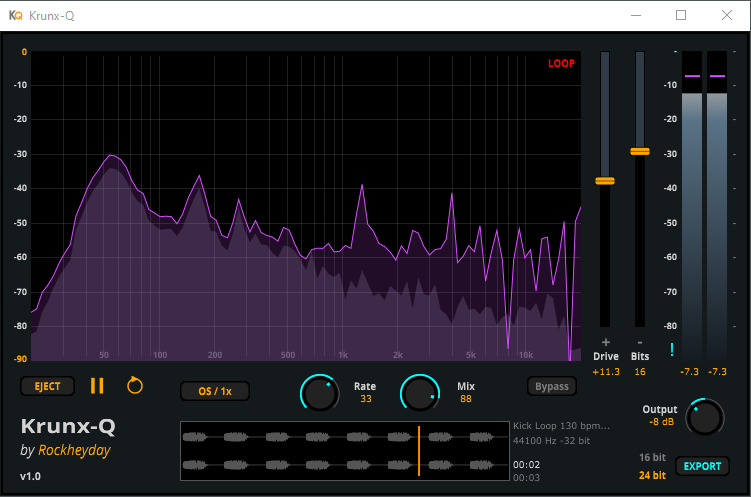
Krunx-Q – Digital Bitcrusher
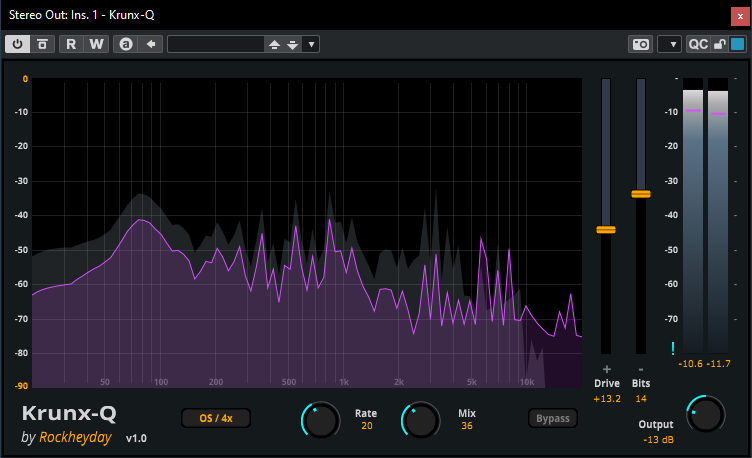
Krunx-Q is a high-precision bitcrusher and sample rate reducer built around a dual-layer FFT analysis engine that monitors both input and output signals in real time. Instead of treating digital degradation as a simple destructive effect, Krunx-Q allows users to visualize the specific spectral artifacts and aliasing generated by the processing — making it easier to sculpt digital noise, manage high-frequency content, and dial in vintage character with surgical accuracy.
KEY FEATURES
• Engine: High-Precision Digital Bitcrusher with resolution-accurate quantization logic
• Bit Depth Control: Stepped integer controls from 24-bit down to 2-bit
• Rate Reduction: Independent sample-rate reduction stage for controlled digital aliasing
• Oversampling: Selectable 1x, 2x, 4x, or 8x real-time oversampling for reduced aliasing
• Analyzer: Dual-Layer Input/Output FFT display for precise harmonic monitoring
• Response Model: Internal 4.5 dB tilt and 350 ms ballistic decay • Gain Structure:
– Drive: 0 to +24 dB (Pre-processing)
– Output: -24 dB to +24 dB (Post-processing)
• Metering: Dual-layer LR Peak meters (background = input, foreground = output)
• Precision: 32-bit floating-point processing
• Sample Rates: 44.1 – 96 kHz (Standalone), Host-Dependent in VST3
Standalone-Only Features
• Playback: Drag & Drop loading with Loop functionality
• Export: Render processed audio to WAV (16-bit or 24-bit)
UNDERSTANDING THE SPECTRUM DISPLAY
While other clippers use a static oscilloscope to show you a flat line of a clipped peak, Krunx-Q uses a high-resolution Dual Layer Spectrum Analyzer. It doesn’t just show you how much volume you removed—it reveals the harmonics and tone you created.
Why does the spectrum “breathe”?
Clipping is a non-linear process. The specific harmonic content generated depends on the exact micro-second a transient hits the threshold. Even in a perfect digital loop, the phase of your kick drum interacts with the clipping threshold slightly differently on every hit.
Krunx-Q’s engine is sensitive enough to capture these micro-dynamic variations. If the visual moves slightly, it is showing you the organic, living nature of the saturation—similar to how analogue gear reacts dynamically to incoming audio.
• 4.5dB Slope: The display uses a calibrated 4.5dB tilt. While standard Pink Noise creates a flat line at 3dB, Krunx-Q uses the steeper 4.5dB slope preferred by mastering engineers. This aligns the visual with modern musical balance, ensuring that if your mix looks flat on screen, it sounds solid in the speakers.
• 350ms Averaging: Krunx-Q uses a specialized 350ms integration time. This mimics the reaction time of a standard VU meter (and the human brain), allowing you to see the “Body” and “Tonal Balance” of the sound, rather than just jittery, instantaneous peaks.